The net worth tracker that replaces your spreadsheet.
Dated snapshots, household views you control account by account, and planning built on your own numbers — with no bank logins anywhere. On the web, on iPhone, and on Android.
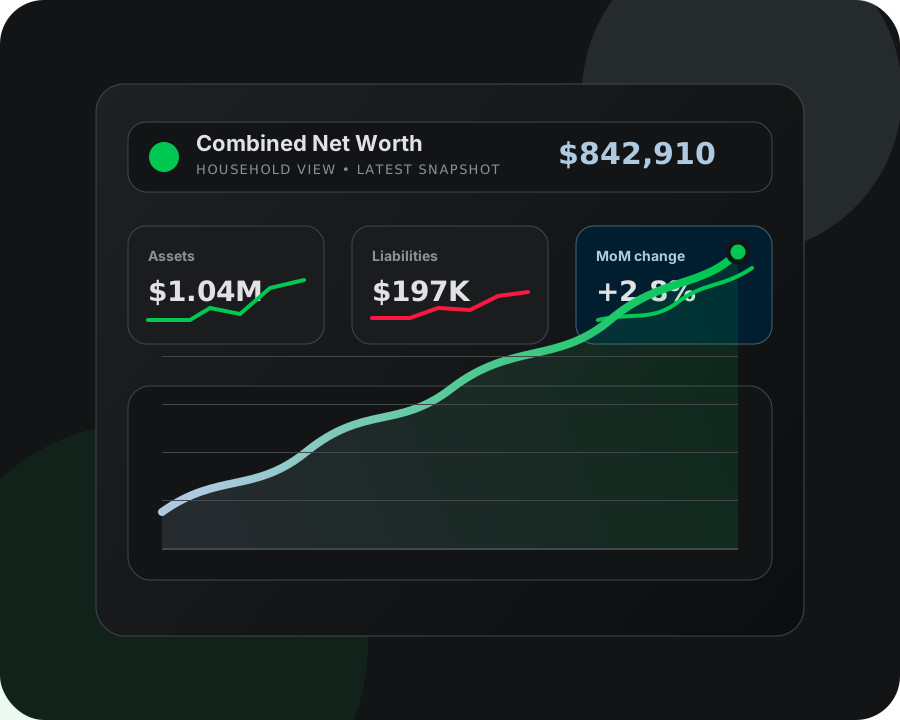
Built for the way real households track wealth.
Not a budgeting toy. A snapshot ledger for people who want reliable trend lines, household collaboration, and enough structure to trust the result.
Snapshot-based net worth
Log balances on the dates you actually have them. Period math picks the snapshot closest to each boundary instead of forcing fake month-end rows.
Household workspace
Every account gets its own workspace at signup. Invite a partner or family member for a shared view, with an activity feed for comments and reactions.
Private vs shared visibility
Each account is private, shared read-only, or shared full-access — so collaboration never means total exposure. One toggle switches My, Shared, and Combined.
A dashboard you arrange
Seventeen widgets — liquidity, percentile, drift, benchmark, streaks, top movers — reordered or hidden to taste. Your layout is saved to your account and follows you across devices.
Property equity, netted
Link a mortgage to the property it finances and read real equity and loan-to-value, instead of an asset row and a liability row that never meet.
Account lifecycle history
Archive a dormant account or consolidate a closed one into its successor — the history moves with it, so your long-term chart never gets an artificial cliff.
Analytics you would otherwise have to build yourself.
Everything here is computed from your own snapshot history — no aggregator, no bank connection, no third party reading your transactions.
Period-delta KPIs
How your net worth moved this month, quarter, or year, with the accounts that moved it ranked underneath and a year-over-year pivot at year end.
Benchmark vs the S&P 500
See where you would be if the money you actually added had tracked the S&P 500 total-return index — priced in index units from your own contribution stream, with no bank login required. Household plan and up.
Allocation & asset-class drift
Where your money actually sits, by category and asset class, with drift from your target mix. Institution-level breakdown and concentration alerts come with the Household plan.
Monte Carlo projections
Project forward from your own contribution history with p10 / p50 / p90 outcome bands, rather than one optimistic straight line. Household plan and up.
Net-worth percentile
A directional read against published age-cohort brackets, computed locally from a static, rounded public-survey table. A reference point, not a leaderboard — and nobody else sees your number.
Ask the ledger
Type a question about your own numbers and get a plain-language answer, generated by deterministic rules over your snapshots. No external model is ever sent your data. Household plan and up.
Plan the whole balance sheet, not just the assets.
Debt, goals, runway, retirement, and the documents you eventually have to hand somebody — all driven off the same ledger.
Debt payoff that simulates
Compare avalanche and snowball side by side with real rollover math: payoff date, total interest, and what one extra monthly payment changes.
0% promo tranches
Model promotional balances as their own tranches so a deferred-interest card is paid down before the rate resets, not after.
Goals, FIRE, and Coast
Set a target and watch real snapshot history close the gap. One active goal is free; multiple goals and the Coast / Lean / Fat FIRE calculator come with the Household plan.
Emergency runway
Liquidity tiers turn “how much cash do I have” into “how many months does it cover” — with your savings rate split into what you contributed and what the market did. Free on every plan.
Insurance & retirement planning
Life, home, auto, and umbrella policies with coverage, premiums, renewals, and documents, plus a retirement income planner with Social Security claiming. Both on the Vault plan.
Reports you can hand over
A year-end tax packet and a lender- or visa-ready net-worth statement, generated as PDFs from the ledger you already keep. Household plan and up.
WorthSync on your phone.
The iPhone app is live on the App Store and the Android app is live on Google Play. Both sign in to the same account as the web app; plans are managed on the web.
Update everything in one pass
Run down your accounts and enter the month in a single sweep. The app remembers what you entered last time and flags what has gone stale.
Entry works offline
Balances logged without a signal queue on the device, dedupe by account and date, and sync when you are back — so the same cell logged twice keeps the latest value.
Locked to you
Optional Face ID or fingerprint lock, and an encrypted on-device cache that is wiped when you sign out.
A trust posture suitable for financial records.
WorthSync is built around explicit ownership boundaries and portable records, not broad client-side trust.
Database-enforced access rules
Row-Level Security puts user-data boundaries in the database itself, so a query cannot return someone else's account even if application code gets it wrong.
Encrypted where it counts
Sensitive financial fields are encrypted at the database level. On the Vault plan an account can be end-to-end encrypted in your browser, so what we store is ciphertext we cannot read.
Your data, forever
Export your complete account and balance history — every snapshot, category, and goal — as CSV, PDF, or full-fidelity JSON whenever you want. Your records are yours to take, with no lock-in.
A public API, not a walled garden
Token-scoped REST endpoints with a published OpenAPI document and signed snapshot webhooks. Read and write your own ledger from anything you like. Household plan and up.
Questions before you sign in
Is WorthSync a budgeting app?
No. WorthSync is focused on net worth: assets, liabilities, dated snapshots, household sharing, and longer-horizon planning. It does not categorise your spending, and it never asks for a bank login.
Can I use it without a household?
Yes, and there is nothing to set up first. Every account gets its own private workspace the moment you sign up — you are a household of one — and solo tracking is free forever. Inviting a partner or family member is optional; that is what turns on shared account visibility and the monthly recap on the paid Household plan.
Do I have to connect my bank?
No. WorthSync is manual-first by design: you enter dated balances yourself. There is no aggregator, no credential vault, and no third party reading your transactions — which is exactly why the benchmark and allocation views work without one.
Is there a mobile app?
Yes — on the App Store for iPhone and on Google Play for Android, both free. They sign in to the same account as the web app, support offline balance entry, and can be locked with Face ID or a fingerprint. Plans are chosen and managed on the web at app.worthsync.com.
Where does the app live?
The application is at app.worthsync.com — that is where you sign in, enter snapshots, and manage your plan. This domain is the public marketing and content layer.